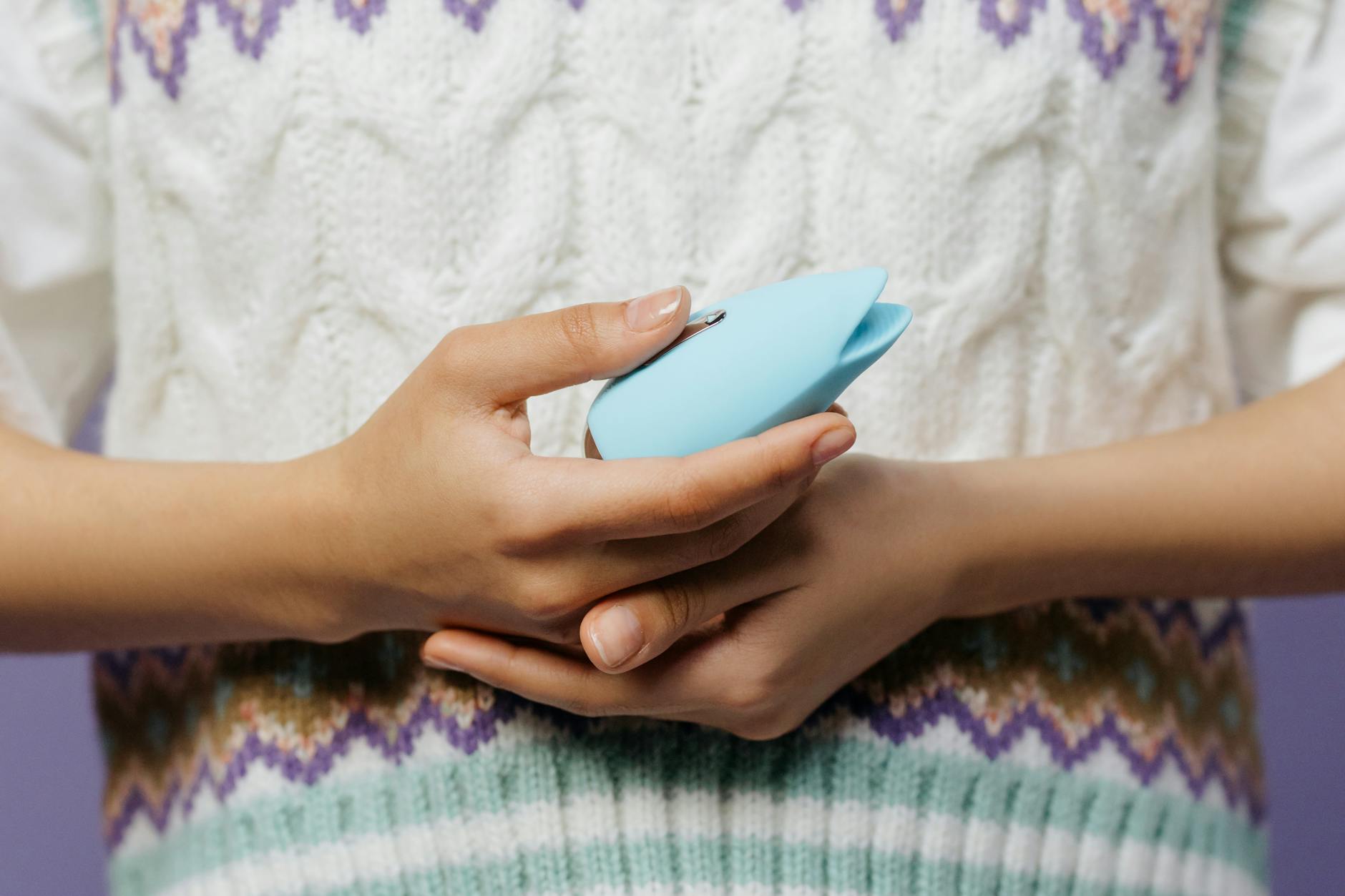
Introducing a clitoral vibrator as a couple doesn't have to feel awkward or complicated. Here's exactly how to have the conversation, choose what works, and use lemon vibrators together without weirdness or tension.
Introducing toys into partnered sex is not a referendum on your relationship. It's not a comment on anyone's performance or a sign that something is broken. It's just a tool, the same way lube is a tool. And yet, bringing it up feels like walking through a minefield because we've been fed decades of messaging that says toys are a last resort, a Band-Aid on a dying sex life, or proof that one person isn't satisfying the other.
Here's the reality: couples who introduce vibrators into their sex life report higher satisfaction, more communication, and less resentment. Not because the toy fixes things, but because the conversation required to introduce it actually fixes things.
Let me break down how to do this without triggering defensiveness, shame, or weirdness.
I've worked with hundreds of couples, and the ones who successfully bring lemon vibrators into their partnered sex life share one thing in common: they separated the conversation about desire from the conversation about tools.
What I mean: "I want more clitoral stimulation during sex" is a different conversation than "I want to try a vibrator." The first is about you. The second is about a thing. If you combine them, your partner's brain reads it as criticism. "You're saying I'm not doing it right." That's not what you meant, but that's what they heard.
So start here. Not with the toy. With yourself.
Pick your angle before you open your mouth. Are you wanting more direct clitoral stimulation because penetration alone doesn't get you there? Are you curious about what different sensations feel like? Did you read something and think, "That sounds interesting"? Are you wanting to speed things up sometimes because you're busy? Pick the actual reason. Be specific.
Then tell your partner. In a calm moment, not during sex. "I've been thinking about my body and what I like. I'd really enjoy more direct clitoral stimulation during sex, and I'm curious about trying a vibrator to explore that together." Notice what that does: it frames it as exploration, as about your pleasure (not their inadequacy), and as something you want to do as a team.
Your partner might say yes immediately. They might also say "Really? Why?" or "Are you not satisfied?" or get quiet.
If they push back, the worst thing you can do is defend the toy. Don't say, "Lots of couples use them" or "It's actually really normal." That reads as "Everyone but you is cool with this."
Instead, go back to the underlying thing: "I want to explore more of what feels good for my body. I've realized I'd love more clitoral stimulation, and I'd really like to do that with you. Would you be open to trying something together?"
You're asking them to be part of your pleasure, not to be replaced by it. Huge difference.
Not all vibrators work the same way in partnered sex. Some are loud. Some require specific positioning. Some feel intense. Some feel subtle. If you're choosing together, here's what matters.
Noise level first. If you live with roommates, have kids, or just prefer discretion, loudness matters. Lemon clitoral vibrators are whisper-quiet compared to most wand vibrators. That alone makes them better for couples because nobody's worried about the neighbors hearing.
Size and access second. Can your partner reach it easily during penetration? Can you both see what's happening? If your partner is inside you, a smaller handheld vibrator like The Lem works better than a large wand because it doesn't get in the way. It's designed to fit between your bodies without creating weird logistics.
Intensity third. If you're sensitive, start with a lower-intensity vibrator. If you've been exploring solo for a while and know you like stronger sensation, pick something that gives you that. But remember: partnered sex is different from solo sex. You might be more sensitive because of arousal, or less sensitive because you're focused on your partner's pleasure too. Don't assume your solo preferences are your coupled preferences.
Set a night for it. Make it feel intentional, not like a desperate last-minute addition to mediocre sex. Light a candle, go to bed a bit earlier, put the phone away. You're signaling to your nervous system that this is normal and good.
Start with clothes on, or partially on. Before you're in the thick of things, let your partner hold the vibrator. Let them experiment with how it feels in their hand. Let them turn it on and off. Let them see that it's just a tool, not a magic wand that replaces them.
Then, when you're actually getting intimate, you can guide it: "A little to the left. Slower. Yes, like that." Your partner gets to be the one controlling the sensation. They're not sitting on the sidelines. They're actively participating in your pleasure. That's the point.
The biggest mistake I see: one partner thinks "We're using a vibrator now" means "Every time we have sex, we use the vibrator." That's not true. Sometimes you use it. Sometimes you don't. Sometimes it's part of foreplay and you set it aside before penetration. Sometimes you use it during. Sometimes you use it after. There are no rules except the ones you make.
Second mistake: Comparing it to what you see online. Porn has a specific aesthetic. Real partnered sex with a vibrator is messier, sometimes less smooth, sometimes less intense, sometimes more intimate. Porn-brain can ruin the actual experience. Go in without expectations.
Third mistake: Not checking in. "Does this feel good?" and "Is this working for you?" aren't sexy questions, but they're necessary ones. Your partner needs to know you're into this, not tolerating it. You need to know they're comfortable. As we explore more about how to use lemon vibrators when your partner wants penetration and you prefer clitoral stimulation, checking in becomes even more critical because you're navigating competing preferences.
Lemon clitoral vibrators use suction technology, not traditional vibration. This changes everything for partnered sex. It feels completely different from what your partner's fingers feel like, so it's not replacing them. It's additive. It's a different sensation, not a better one. That distinction matters psychologically.
The suction is also intense without being loud, localized without being weird during penetration, and controllable without being complicated. You're not hunting for the right speed. You're not managing multiple settings. You press it on, adjust intensity, and go.
For couples who are new to toys together, that simplicity removes one source of awkwardness. You're not fumbling with buttons while someone's inside you. You're just using it.
Talk about it. Not during, not when you're getting dressed. The next morning, or later that day. "That felt really good." Or "That was interesting, but I think I'd like to adjust how we use it next time." Or "I loved seeing you enjoy that." Make it normal conversation.
And if it didn't work the first time, that's fine too. Sometimes positioning is off. Sometimes the pressure is different than expected. Sometimes your nervous system just wasn't ready. Try again. Adjust. Be patient with each other.
The goal isn't a perfect experience. The goal is building a relationship where you can talk about sex, explore together, and prioritize each other's pleasure without shame. A vibrator is just the excuse to have that conversation.
No. Think of it the way you think about lube. Sometimes you use it, sometimes you don't. Sometimes your body needs it, sometimes it doesn't. Using a vibrator during coupled sex doesn't rewire your nervous system to only respond to vibration. You're adding an option, not replacing your partner's touch. Many couples use them intermittently, not every single time. The flexibility is part of the appeal.
This comes down to framing and reassurance. The clearest way to prevent that interpretation is to frame it before you even bring a toy into the conversation: "I want to explore new sensations together. I've realized I'd love more clitoral stimulation, and I'd really like to do that with you. Would you be interested in trying something together?" That last phrase matters. You're not asking if they want to be replaced. You're asking if they want to participate in your pleasure in a different way. Keep coming back to that framing.
Start small. You don't have to lead with toys. Start with what you like during sex now. "I really enjoy when you touch me here." Or "I love when we slow down." Build the muscle of talking about sex. Once you can say "slower" without embarrassment, saying "I'd like to try a vibrator" is easier. The real barrier isn't the vibrator. It's permission to talk about sex at all. Create that permission first.
Nope. I've worked with couples married forty years introducing toys for the first time, and couples together six months doing it. The variable that matters is comfort with communication, not time together. If you can have a difficult conversation with your partner and feel heard, you can do this. If you can't yet, work on that first. The toy will still be there.
That's worth exploring separately from the partnered conversation. Sometimes self-consciousness about pleasure is rooted in childhood messaging, sometimes in past relationships, sometimes in body image stuff. How to use lemon clitoral vibrators when you feel self-conscious about pleasure goes deeper into this. But the short version: you deserve to enjoy your body, and your partner gets to witness that. Their job is to be present and supportive, not to judge. If they judge, that's a different conversation entirely.
Yes. That's one of the main reasons lemon clitoral vibrators work so well for couples. The shape is designed to be compact and to fit between your bodies without creating weird logistics or discomfort. During penetration, your partner can hold it, or you can, depending on positioning. Missionary, spooning, you on top, you on your back. All work fine. The key is not overthinking the mechanics. You'll figure it out as you go.
Introducing a vibrator as a couple isn't about fixing sex. It's about deepening communication, normalizing pleasure as a shared priority, and giving yourselves permission to be curious together. The toy is just the vehicle for that conversation.